Choosing the 2026 best lighting for green building certification requires more than selecting efficient LED fixtures. Lighting For Green Building Certification must support energy savings, visual comfort, daylight use, and responsible building operation.
In practice, a project may use high-efficiency lamps yet lose value through glare, poor controls, or unnecessary nighttime lighting. A daylight sensor beside a window can reduce energy use, but only when it is correctly calibrated. Small details matter. This guide examines LED efficacy, occupancy sensors, dimming systems, daylight harvesting, color quality, and maintenance planning. It also considers how lighting choices may support systems such as LEED, BREEAM, WELL, and other regional programs.
Experienced design teams usually begin with the certification criteria, not a product brochure. They review lighting power density, illuminance levels, glare risks, control zones, and commissioning records. A quiet office may need soft, stable illumination, while a warehouse requires reliable coverage at greater mounting heights. Different spaces demand different evidence.
No fixture guarantees certification. Requirements can change, and local interpretations may differ. Always verify current criteria through official certification bodies and qualified lighting professionals. This article will compare practical solutions, installation concerns, and long-term operating performance.
Real buildings behave differently.
Simulation results may look perfect, while dusty sensors, blocked windows, or poorly trained occupants reduce actual savings. That limitation deserves attention. The best approach combines measurable performance, occupant feedback, documented maintenance, and honest review after installation.
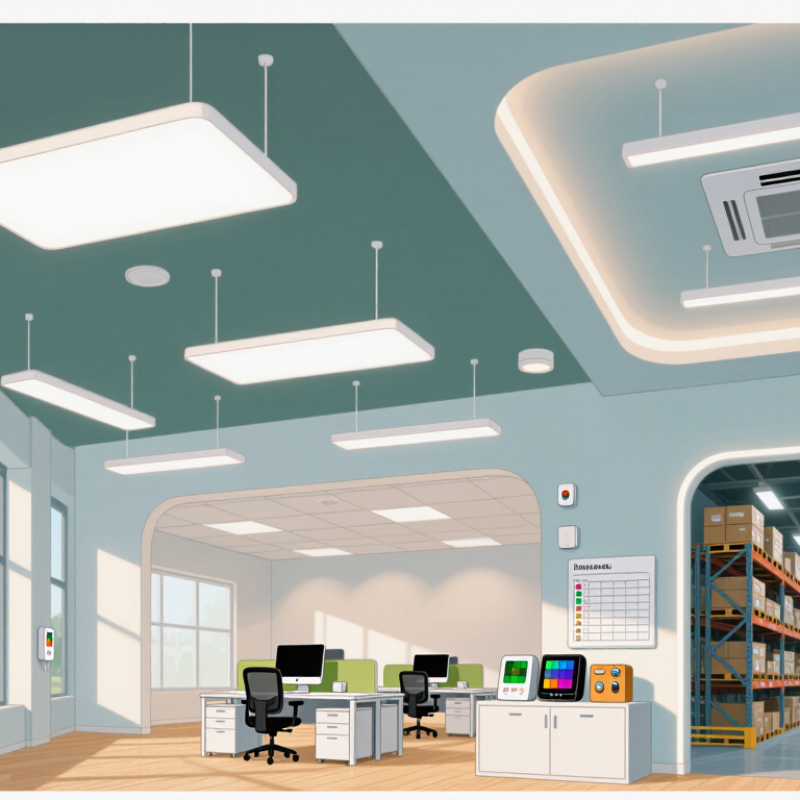
In 2026, green building lighting certification measures more than low electricity use. It examines lighting power density, control strategies, daylight access, glare, and occupant comfort. Requirements vary by certification system and project location. Check the current technical manual before selecting equipment.
A compliant design often uses occupancy sensors, dimming controls, scheduling, and daylight harvesting. Auditors may review lighting layouts, control zones, energy models, product data, and commissioning records. A bright room is not automatically a healthy room. Excessive blue-rich light or glare can reduce comfort, especially near screens and windows. Good projects balance measured performance with real user experience.
Tips: Measure the space after installation. Record illuminance at desks, corridors, and task areas. Test sensors during occupied and vacant periods. Keep invoices, control settings, and commissioning notes together. Do not assume every efficient fixture earns certification points. I have seen designs meet energy targets yet disappoint occupants because controls were confusing. That gap deserves honest review. Consider maintenance access, lamp replacement, and future software changes. These practical details can protect performance long after the inspection.
What Green Building Lighting Certification Measures in 2026
How to read this chart: Maintained illuminance targets are a core visual-comfort reference in green building assessments. The values shown are commonly specified targets for typical interior spaces under EN 12464-1:2021.
In 2026, green building lighting reviews typically consider more than illuminance alone, including lighting energy use, automatic controls, daylight availability, glare protection, color quality, occupant control, and light pollution reduction. Efficient LED systems, daylight-responsive dimming, occupancy sensors, and documented commissioning can help support these requirements.
Reference: EN 12464-1:2021, Light and lighting — Lighting of work places — Part 1: Indoor work places. Actual certification requirements vary by rating system, building type, and project scope.
2026 Best Lighting for Green Building Certification?
How to Choose Energy-Efficient Lighting for Certified Buildings
Certified buildings need more than efficient lamps. Lighting must support energy targets, occupant comfort, and documented performance. Start by checking fixture efficacy, measured in lumens per watt. High efficacy reduces electricity use, but it does not guarantee a successful project. Poor glare control, uneven illumination, or visible flicker can create complaints and reduce productivity.
Review the building’s lighting power density before selecting equipment. Compare the proposed load with the certification framework’s requirements and the local energy code. Use daylight sensors near windows, occupancy controls in meeting rooms, and scheduling for areas with predictable use. Controls should be commissioned after installation. A sensor aimed at a reflective wall may behave badly. Small details matter.
Choose color quality for the task. Offices often need comfortable, consistent light, while workshops may require stronger visual clarity. Check color rendering, glare ratings, flicker performance, and maintenance access. Long service life can reduce replacement waste, yet manufacturers’ claims deserve verification through test reports and project records. Keep photometric files, control settings, invoices, and commissioning results together. That evidence supports certification reviews.
In practical design reviews, teams sometimes chase the lowest wattage and overlook user behavior. This is a mistake. Occupants may disable confusing controls or add unauthorized lamps. A short trial installation can reveal these problems before full deployment. Measure energy use after occupancy, because the first design is rarely perfect.
| Lighting Solution | Typical System Efficacy | Typical Rated Life | Color Quality | Control Compatibility | Energy and Maintenance Profile | Certification Relevance | Best-Fit Applications | Selection Priority |
|---|---|---|---|---|---|---|---|---|
| Core technology comparison | ||||||||
| LED luminaires with advanced controls | 100–180 lm/W | 50,000–100,000 hours | CRI 80–95; multiple CCT options, commonly 2700–5000 K | Excellent compatibility with occupancy sensors, daylight dimming, scheduling, addressable control, and energy monitoring | Lowest overall energy demand among common commercial options when properly designed; long life reduces relamping and maintenance access | Strong option for energy, lighting-quality, controls, and operational-performance objectives in major green-building programs | Offices, schools, healthcare, retail, hospitality, warehouses, and public buildings | First-choice baseline for most new construction and renovation projects |
| LED retrofit lamps | 80–150 lm/W | 25,000–60,000 hours | CRI 80–90; CCT typically 2700–5000 K | Depends on lamp and fixture; dimming and sensor performance must be verified | Can reduce energy use without replacing the entire fixture; performance depends on existing housing, thermal conditions, and optical distribution | Useful for renovation energy improvements, but documentation must demonstrate installed performance and control effectiveness | Existing offices, corridors, classrooms, parking areas, and residential common spaces | Good for phased upgrades where full luminaire replacement is impractical |
| High-efficiency linear LED | 130–190 lm/W | 50,000–100,000 hours | CRI 80–90; CCT commonly 3500–5000 K | Strong support for occupancy sensing, daylight harvesting, networked control, and continuous dimming | High efficacy and uniform illumination can reduce fixture count and connected load; suitable for lower-maintenance layouts | Well suited to projects targeting reduced lighting power density and controllability | Open-plan offices, classrooms, production areas, and warehouses | Prioritize optical efficiency, glare control, and sensor zoning |
| LED high-bay lighting | 130–200 lm/W | 50,000–100,000 hours | CRI 70–90; CCT commonly 4000–5000 K | Occupancy sensors, high-low controls, daylight dimming, and wireless or wired systems are commonly available | Can substantially lower energy use in high-ceiling spaces; long life minimizes lift equipment and relamping labor | Supports energy and controls documentation for industrial and large-volume spaces when zoning and schedules are properly commissioned | Warehouses, sports facilities, manufacturing areas, and distribution centers | Select beam angle and mounting height using photometric calculations |
| LED troffers and recessed panels | 100–160 lm/W | 50,000–100,000 hours | CRI 80–95; low-glare versions are available | Excellent compatibility with dimming, occupancy sensing, daylight response, and room-based control | Efficient general lighting with good uniformity; low-glare optics can improve visual comfort and reduce complaints | Supports energy reduction, glare management, and indoor-environmental-quality strategies | Offices, classrooms, libraries, and healthcare support areas | Compare UGR or equivalent glare data, shielding, flicker, and maintenance access |
| LED exterior and site lighting | 90–160 lm/W | 50,000–100,000 hours | CRI 70–90; CCT commonly 2200–4000 K | Photocells, astronomical time clocks, motion sensing, dimming, and network controls | Efficient operation with strong scheduling potential; careful optical design can reduce spill light and uplight | Relevant to exterior-lighting power, light-pollution reduction, safety, and site-performance objectives | Parking areas, walkways, campuses, streets, and building façades | Prioritize shielding, controlled CCT, adaptive dimming, and compliance with local light ordinances |
| Fluorescent lighting | 60–100 lm/W | 15,000–36,000 hours | CRI 80–90; common CCT range 3000–5000 K | Compatible with some dimming and occupancy controls, but control selection can be more limited than with modern LED systems | Higher energy and maintenance burden than current LED alternatives; contains mercury and requires appropriate end-of-life handling | May remain in existing buildings, but is generally less competitive for new green-building projects | Legacy offices, schools, retail spaces, and utility areas | Consider replacement during major renovation or when lamps and ballasts require frequent servicing |
| Halogen or incandescent lighting | 10–25 lm/W | 1,000–4,000 hours | CRI close to 100; warm CCT, commonly 2700–3000 K | Dimming is generally straightforward, but energy use remains high | Very high electricity consumption and frequent relamping compared with LED; substantial heat output can increase cooling demand | Generally unsuitable as the primary technology for energy-focused certified buildings | Specialty decorative or heritage applications where alternatives cannot meet visual requirements | Use only when a documented design constraint justifies the energy penalty |
| Key specification checks before procurement | ||||||||
| Lighting power density | Calculate installed watts per unit area for each space type; include all connected lighting loads covered by the project boundary | Use the actual fixture wattage, control devices, emergency lighting loads, and operating zones—not only nominal lamp wattage | Compare the design against the applicable energy code and certification pathway. Lower power density is valuable only when required illuminance and visual comfort are maintained. | |||||
| Controls and zoning | Provide occupancy or vacancy sensing where appropriate, automatic daylight response near windows, and time scheduling for intermittently occupied areas | Separate zones according to daylight availability, occupancy patterns, task requirements, and after-hours use | Document control sequences, sensor coverage, setpoints, calibration, and commissioning results. A highly efficient fixture cannot deliver expected savings if controls are poorly configured. | |||||
| Visual comfort and health | Review glare metrics, shielding, luminance, flicker performance, uniformity, and contrast—not efficacy alone | Select CRI and CCT according to task, occupants, local design requirements, and project goals | For offices and learning spaces, low-glare optics, appropriate vertical illumination, and stable dimming can improve usability and occupant satisfaction. | |||||
| Documentation and verification | Collect photometric files, tested wattage, rated life, lumen-maintenance data, control specifications, warranty terms, and disposal information | Confirm that submittals match the installed products and that field settings match the approved design | Keep commissioning records, as-built schedules, control-zone diagrams, and measurement or verification results for certification review and future operations. | |||||
| Best overall 2026 selection strategy | Use efficient LED luminaires as the baseline, then optimize optics, power, controls, daylight response, and maintenance access | Specify performance requirements rather than relying only on fixture type or a single efficacy value | The strongest certified-building design balances low energy use, controllability, visual comfort, durability, responsible materials, and verifiable operational performance. | |||||
Lighting technologies can support green building standards when they reduce energy use without harming comfort. High-efficiency LED systems remain practical because they provide strong output with lower power demand. Their value depends on measured performance, not product claims.
Daylight sensors can dim fixtures near windows as sunlight changes. Occupancy sensors reduce unnecessary lighting in meeting rooms, corridors, and restrooms. Networked controls also provide useful energy data for certification documents.
However, poorly commissioned controls may frustrate occupants and encourage manual overrides. Controls matter.
Good design considers more than watts. Low-glare optics can improve visual comfort in open offices and classrooms. Appropriate color quality supports accurate work and a calmer indoor environment. Tunable white lighting may support changing schedules, but it should be tested carefully. More features do not always create better outcomes.
Design teams should document lighting power density, control sequences, zoning, and commissioning results. Many standards also reward daylight access, responsible materials, and ongoing performance monitoring. Requirements vary by certification system, location, and project version. Reviewing the current criteria early prevents expensive redesigns. In practice, a simple, well-adjusted system may outperform an advanced system that nobody understands. I still question whether every smart feature deserves installation, especially when maintenance resources are limited.
Lighting controls can turn a compliant design into measurable building performance. Occupancy sensors reduce unnecessary runtime in meeting rooms, corridors, and restrooms. Daylight dimming lowers electric lighting when sunlight reaches work surfaces. Scheduling also prevents lights from operating during empty hours. These details support energy models and create clearer evidence for certification reviews. Small savings matter.
Good controls need practical commissioning, not just impressive specifications. Sensors should be positioned away from air vents, direct sunlight, and blocked furniture. During site testing, technicians can compare sensor readings with actual occupancy patterns. Facility staff should also receive simple instructions for overrides and adjustments. Confusing interfaces often encourage permanent manual settings, which weakens expected savings.
Documentation strengthens credibility. Keep control sequences, zoning plans, commissioning records, and trend data in one accessible file. Monthly reports can show runtime, dimming activity, and unusual energy use. However, automated data is not always accurate. A poorly calibrated sensor may report an empty room as occupied. Human checks remain necessary. Not every strategy works perfectly. Review seasonal behavior, listen to occupants, and revise settings when comfort complaints appear. A quieter corridor, stable desk lighting, and fewer after-hours complaints can reveal performance that spreadsheets miss.
For 2026 green-building certification, the best lighting is not simply the most efficient fixture. It is a system with traceable performance, reliable controls, and complete records. The International Energy Agency reports that lighting uses about 15% of global electricity. This makes lighting evidence important during certification reviews.
Start with a room-by-room compliance matrix. Record fixture wattage, delivered lumens, color temperature, glare data, control zones, and operating schedules. Compare these values with the project’s approved energy model and applicable requirements, such as ASHRAE 90.1. Ask for photometric files and independent test reports. LM-79 verifies solid-state lighting performance, while LM-80 and TM-21 support claims about lumen maintenance. Paperwork matters.
During commissioning, measure illuminance at occupied work surfaces. Photograph sensors, daylight zones, and control panels. Test vacancy settings, dimming response, and after-hours shutdowns. Save date-stamped results. The U.S. Department of Energy’s commercial lighting studies show that controls can reduce lighting energy use substantially, yet poorly calibrated systems often weaken those savings. A real project may reveal uneven light near a window. Fix it, then retest. That small failure is useful evidence.
Keep invoices, product schedules, submittals, calibration certificates, and change orders together. Avoid copying modeled savings into the final report without verification. Metered data can disagree with assumptions. Explain why. Clear explanations build credibility.
It measures lighting power density, control strategies, daylight access, glare, and occupant comfort. A bright room is not automatically healthy.
Efficient LED systems, daylight sensors, occupancy sensors, dimming controls, and scheduling can support certification. A simple system may work better.
No. Certification usually depends on measured performance, control operation, documentation, and project requirements. Product claims alone are insufficient.
They dim fixtures near windows when sunlight increases. This can lower electricity use while maintaining desk illuminance. Test the response carefully.
Auditors may review control settings, energy models, product data, layouts, and commissioning records. These documents show whether the installed system performs as designed.
Measure illuminance at desks, corridors, and task areas. Test sensors during occupied and vacant periods. Keep records.
Yes. Confusing controls may frustrate occupants and encourage manual overrides. A system can meet energy targets yet disappoint users. That gap deserves review.
Low-glare optics can improve comfort near screens and windows. Excessive blue-rich light may also affect visual comfort. More features do not always create better outcomes.
Consider maintenance access, lamp replacement, software changes, and long-term performance monitoring. I still question every smart feature when maintenance resources are limited.
Lighting For Green Building Certification in 2026 focuses on how effectively a building’s lighting system reduces energy use, supports occupant comfort, and meets measurable sustainability goals. Certification reviews may consider lighting power density, energy efficiency, daylight integration, glare control, visual quality, and the system’s effect on overall building performance. Selecting efficient fixtures with suitable color quality, long service life, and low maintenance needs can help projects achieve these objectives while reducing operational costs.
Advanced lighting technologies, including high-efficiency solid-state systems, occupancy sensors, daylight-responsive dimming, scheduling, and centralized controls, can further improve certification performance. These solutions allow lighting to respond to real-time occupancy and available daylight instead of operating at full output continuously. To verify compliance, project teams should maintain product data, lighting calculations, control specifications, commissioning records, and energy performance results. Clear documentation demonstrates that the installed system performs as designed and supports the project’s sustainability claims.

Boffo Lights